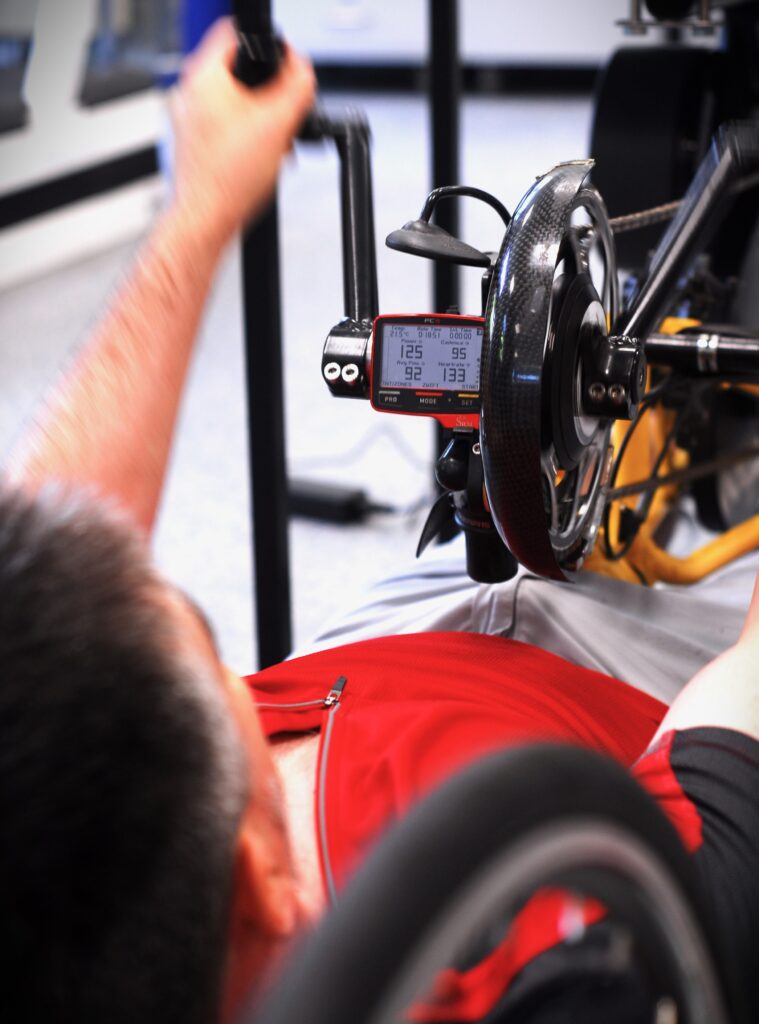
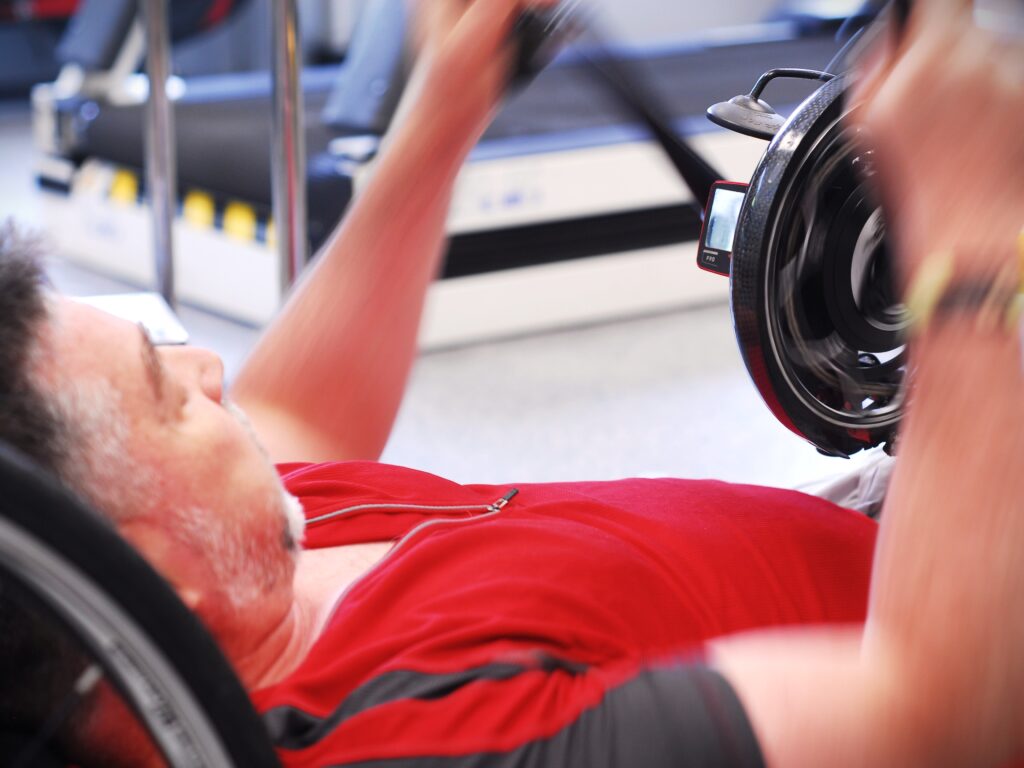
Battle Mountain, AKA WHPSC, is, as previously mentioned, a fusion of engineering and human performance. Succeeding at Battle Mountain is all about the fine optimisations. While the engineers are in Liverpool optimising the bike design, I’m doing the same with my body and mind.
Environments
In 2017, when I started my journey to my original world records I looked at as many variables and factors as I could. In doing so, I quickly had to prioritise which variables were the most critical and which needed help from external experts. One that I’d looked at was the actual racing environment that is Highway 305. Battle Mountain is a high desert town and at about 1300 metres in altitude and with September temperature sometimes reaching 40 degrees C, it creates a rather hostile environment in which to be sealed inside a container with effectively no ventilation while being expected to work as hard as possible… especially for someone who is training in a complete opposite environment in chilly, sea-level, Scotland. Unfortunately, unlike with the bike, and the strength and cycle coaching, I didn’t have experts to turn to in order to optimise this… no did I know just how insanely hot Battle Mountain gets.
What’s a modern boy to do?
Well, the obvious solution for 2025 was to just train inside with the windows closed and with no cooling fans. Then, try to find a hypoxic breathing system and hope for the best, right? That’s heat and altitude, should be good! Well, it turns out no, but boy did I try that. I got as far as the lack of cooling (which I was, appropriately, told off for!) but the hypoxic breathing system was a bit trickier.
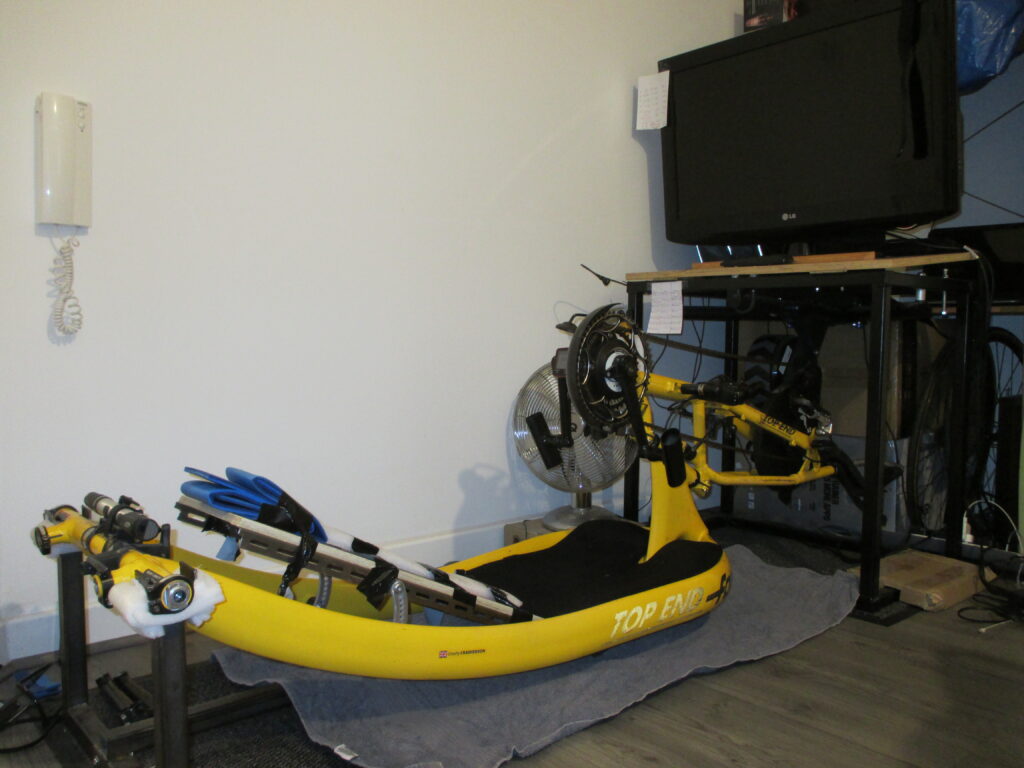
As I’ve been training with AM Fitness at the University of Edinburgh I realised the Uni had a pretty big Sport, Physical Education, and Health Sciences Programme so I thought it couldn’t hurt to ask them if they maybe had something I could rent or borrow.
In a roundabout way they did
Welcome to the Environmental Human Performance Lab

I heard back from Jenni, one of their lab technicians, and it turns out the University had just recently build an Environmental Human Performance Lab and they thought my World Record Attempt was possibly a worthy reason to try it out. Word went out to Senior Lecturer, Dr Shaun, and a meeting was arranged with the two of them alongside my strength coach and me.
We had a brilliant discussion over coffee where I shared my dramatic tale of success and achievement, intermixed with the sad and woeful tale of thievery. While Shaun and Jenni told me about the lab and how it might benefit me.
And thus began the first steps of our collaboration, which has proven to be very interesting indeed.
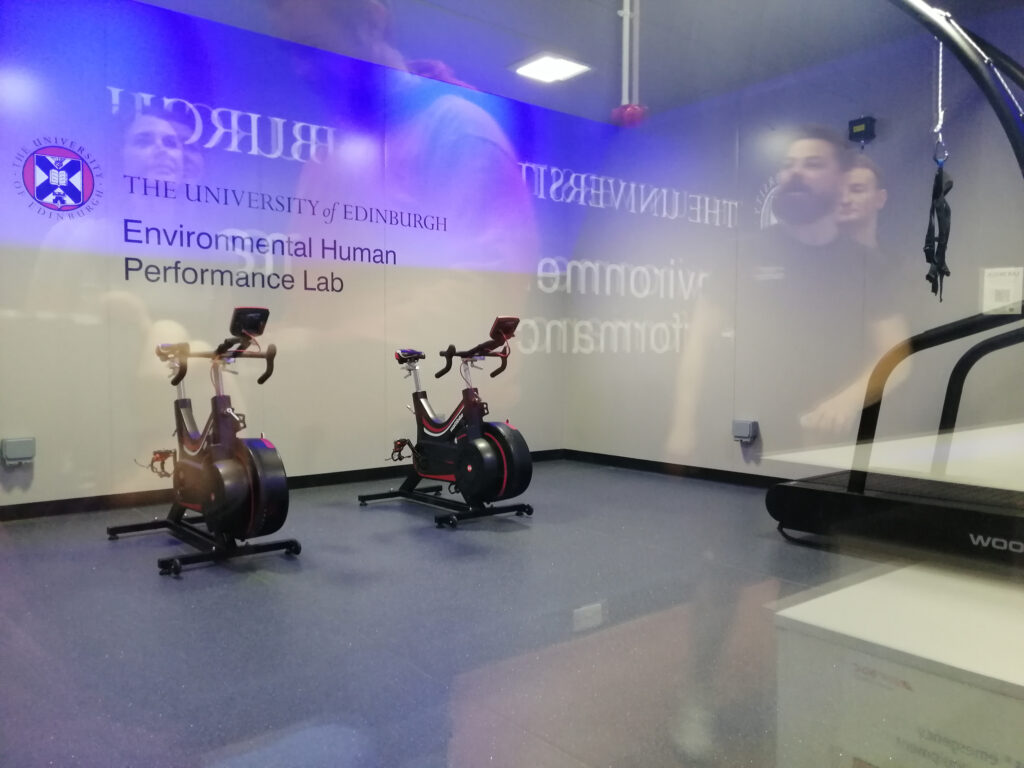
The Environmental Human Performance Lab, it turns out, is very well suited towards helping me adapt to the environment at Battle Mountain. It’s got a controlled environment that capable of reaching temperatures from -50 to +50 deg C, and it can decrease oxygen levels to simulate altitudes of 5000 metres. Of course it’s got a team of specialists trained in Physiology and while it’s suited for training, it’s other use, research, is particularly important here because it turns out that there’s pretty much no research data for handcyclists operating at high performance levels in extreme heat and altitude. So, I get to be a guinea pig!
After a number of meetings, the team at the lab and I came up with a plan to get started and off we went.
Lactate Threshold Tests
The first step in the plan was to get reverence measurements so over two days, two months apart we did Lactate Threshold tests in standard ambient temperatures. If you’ve not done a Lactate Threshold test these are good fun; you simply ride for a prescribed duration at a specific power. After the first timeframe has been completed you go to the next power level for the same amount of time, and you keep repeating this. In our test I was riding for four minutes each time and increasing my power by 15 minutes. The interesting thing about this that as you progress and your power increases, you don’t decrease the duration that you’re holding that power, so while the low power intervals are easy, they get progressively more difficult because in the real world, the harder you’re working, the less time you spend at that level.
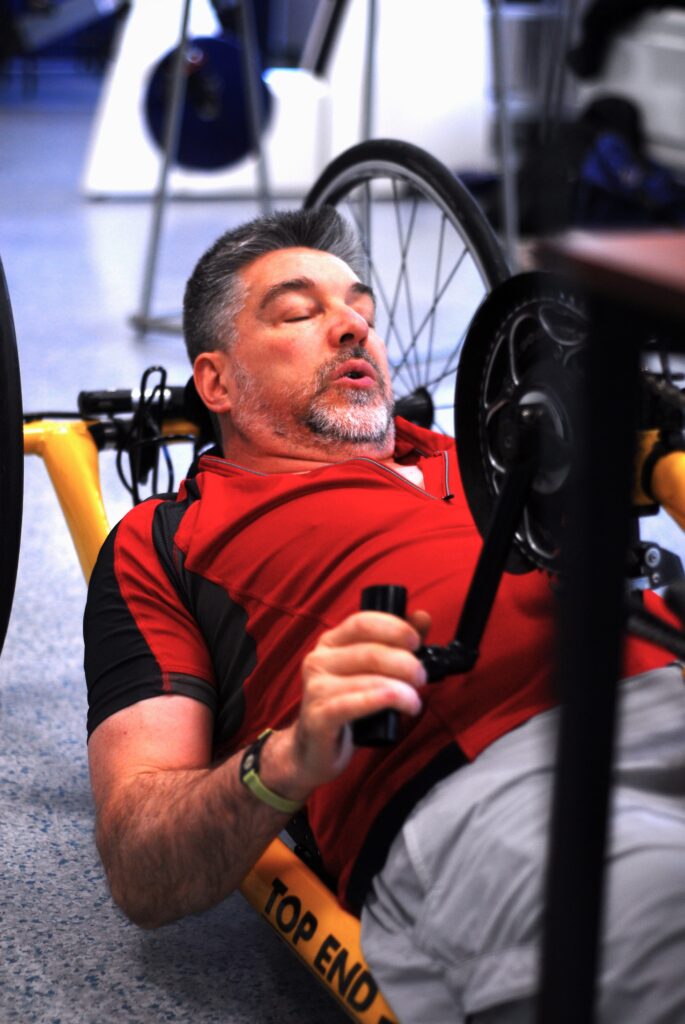
Vampires!
While I was riding, I’d be giving evaluations of what I was feeling as part of the measurements, but critically, one other key measurement was being taken through blood samples. So, in addition to the power changes every four minutes, I was being poked with a needle in my ear and having some blood drawn for analysis.
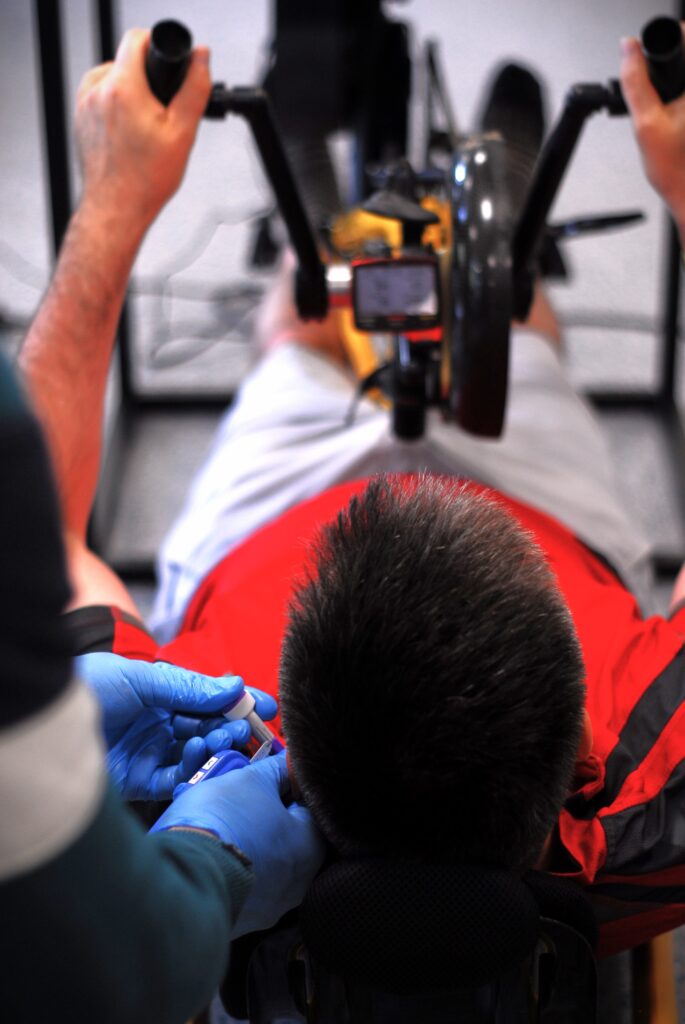
I’m no expert on the exactly how the process work, but essentially, the blood test is looking for the exercise intensity where blood lactate begins to accumulate faster than the body can remove it, and it’s an indicator as to where fatigue will set in.
We did Lactate Threshold Tests twice, two months apart to get a comparison and the handy thing is that we had the results of another Lactate Threshold test that I did with Paul at Cardiff Metropolitan University during my build-up to the 2018 record attempts. Now, while I understand that it’s not necessarily a valid comparison, my first threshold for 2025 was better than for 2018. And the second threshold test for 2025 was noticeably better, and this CAN be compared.
And with those references sorted, we waited until we could really get down to business in the lab… but what would it be like? How hot would it get? How little oxygen would I get? Only time will tell…