Intro
For those of you who aren’t familiar, or haven’t read the rest of the blog, let’s just have a refresher as to what the WHPSC is.
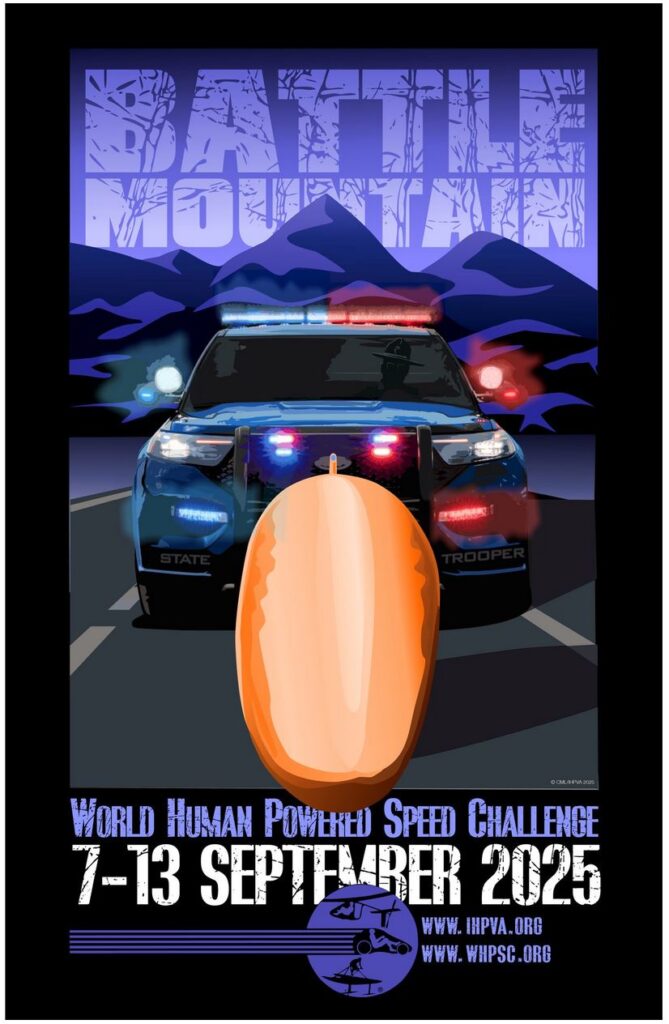
WHPSC is the World Human Powered Speed Challenge, also affectionately known as Battle Mountain due to the town that the event takes place in.
Simply, this is a bike race where participants try to go as fast as they can.
“Big deal,” you say, “Every bike race has people trying to go as fast as they can, what’s so different about the WHPSC?”
Well, where most bike races will feature bikes similar to what you would find at your local bicycle shop, the WHPSC bikes are very different. And where races like the Tour de France or local club races might have rules about the bikes governed by organisations like the UCI (Union Cycliste Internationale), WHPSC rules are very different. And importantly, the speeds are very different- leg powered riders are pushing just under 90 mph while handcyclist such as myself are targeting achieving over 50 mph.
The Tech
I’ll oversimplify a bit here…
The WHPSC, brought to you by the International Human Powered Vehicle Association (IHPVA), is an opportunity for engineers and cyclists to come together to push the boundaries of design and performance. As such there aren’t many limits on what can be created and this results in designs very different from what you’d find at your local bike shop because the designers, engineers, and builders have a lot of leeway in what they can design.
First the bikes are generally recumbents in design, bike that you lie down on. Additionally, the bikes have fairings or shells made of materials like carbon fibre and Kevlar to make the bikes as aerodynamic as possible. Finally, the bikes generally have no windows* and utilised camera systems and screens for so the rider can see where they’re going. But, the one key feature is there can be nothing external to the rider that helps in power generation – no motors, no cooling fans, not even ice packs. These bikes are all purely human powered.
*There is a subtle deviation here with Velomobiles though.
How it works
The race itself is relatively simple.
There are potentially three courses depending on what type of bike you’re on and what rider is powering the bike. The short course is 2.5 miles with a 200 metre timed section. The long course is 5 miles with a 200 meter timed section, and there’s a special course of 600 metres. Riders simply set off, use the length of the course to build up as much speed as they can, then carry that through the timed 200 metre section to get their maximum speed.
The short course is generally used for qualification and youth riders, handcyclists, such as myself, get to do an extra, single, attempt on the 600 metre course, but the records are generally set on the long course.
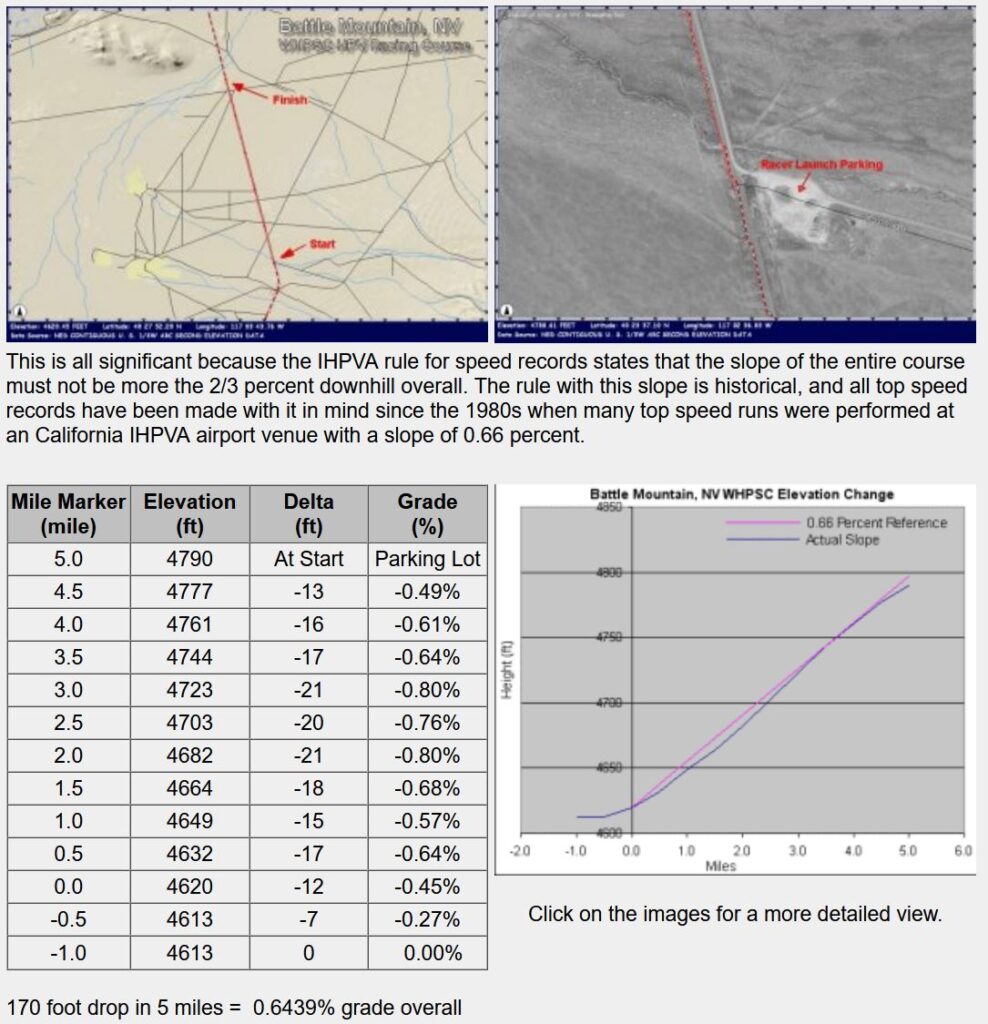
The “race track” is Highway 305, two lanes, just outside the lovely town of Battle Mountain, Nevada in the U.S. The road is incredibly straight and incredibly flat – perfect for the goal of the WHPSC. The racing takes place for a couple hours in the morning, then again in the evening just before sunset for about six days. When racing, the highway is closed and up to five bikes are set up in succession in the start line. At a specific time, they are set off each following the other at, I believe, one minute intervals, much like a traditional Time Trial. The slight difference to a traditional Time Trial is that each bike is allowed a push start. This is mainly due to the fact that many of the bikes are geared so high that they’d struggle to accelerate without tipping over. Once off, the racers proceed to accelerate until they get to the timed section and carry their speed through. Once past the finish flag they have 2/3 mile to decelerate into the catch area.
Variables and Crashes
Wind
The primary variable the teams have to face is wind speed. Race rules state that the wind must not be blowing in any direction at greater than 6 kilometers per hour or 1.67 meters per second. In part this is due to the risk of crosswinds making the bikes harder to control, but also a headwind results in a slower speed for the same effort, and who wants’ that when you’re going for a world record? Most teams ride if the wind is calm as it’s possible to expend a lot of energy only to have the wind gust during the 4-8 seconds that you might be in the timing zone.
Heat and Altitude
Battle Mountain is hot and high. If you live and train at sea level, the altitude of 1,307 metres and the decreased levels of oxygen can have an impact on performance. But more so, even in September the area gets hot. In 2018 there were reports of temperature in the realm of 40 degrees C. Combine that with being sealed in carbon fibre shell that’s trapping all the heat your body is generating while working at maximum effort and well, those bikes get a wee bit toasty inside – and that heat significantly degrades performance.
Crashes
Crashes do happen at all points on the course. Many of the bikes are two wheeled and surface area of the shells do make them prone to getting caught in crosswinds which can affect control. Additionally, launches can be a challenge for the two wheeled bike in getting up to speed and balancing the bike. Lastly, catch can be tricky; the riders are exhausted by this point, but they still have to be focused to bring the bike into catch with enough speed that they don’t tip over but slow enough that their team, literally, catch the bike with their bare hands.
Who does this?
The World Human Powered Speed Challenge attracts individuals and teams from the world over. Some are local to Battle Mountain, others from various parts of the U.S., Canada, Australia, Japan, various parts of Europe and of course, ULV Team (University of Liverpool) from the UK. Some teams are families, others are individuals or friends, but many teams are, much like ULV Team, Universities where the bikes are designed and built by engineering students as part of their degree programmes. Some of the teams are racing home-built bikes, others are racing commercially available Velomobiles, and others racing bikes built by those engineering students.
No matter where they’re form and who or how they built their bikes, the one thing that everyone shares at the WHPSC is the desire to go fast. Whether it’s a personal record or a world record it’s ultimately one simple shared goal.
Why do it?
First and foremost, despite it looking like torture for the riders, it’s actually very fun. Though, maybe you have to have particular personality for that. Engineering-wise, while I’m no expert, I can tell you that through my own initial efforts that it’s a very fun puzzle to work out just how best to optimise a bike for a specific rider or two as well as the environment. Much like how the training is on the cutting edge of what is possible, so is the engineering. Training-wise, it’s challenging, I’d argue that it’s brutal . I don’t think I’ve ever pushed myself so hard both physically and mentally to achieve what I did in 2018 or what I plan to do in 2025. Despite the brutality of the training though, it’s still been very fun, and an amazing learning experience on many levels.